Posted on

Yule 2025: Celebrating the Return of the Sun

๐ŸŽ„ The Longest Night is Over!

Welcome, fellow seekers of light! As the Wheel of the Year turns to its darkest point, we arrive at the beautiful and hopeful Sabbat of Yule. This is a powerful, transformative time when we honor the deepest dark and celebrate the miraculous return of the light.

EventDate & Time
YuleSunday, December 21st 2025, at 6:02 am CST
Traditional DurationThe celebration often lasts for 12 days, extending to January 1st (The 12 days of Yule)
SignificanceThe longest night and the official rebirth of the Sun, signaling the shift towards longer days

Yule, or Yuletide, is one of the oldest and most universally recognized winter celebrations, marking the Winter Solstice. It is the shortest day and the longest night of the year in the Northern Hemisphere.

Ancient Roots:

Yule’s roots are deep, tracing back to the Norse, Germanic, and Scandinavian traditions. Originally called Jรณl (pronounced ‘yohl’), it was a midwinter festival that involved feasting, drinking, and honoring the gods (like Odin/Jolnir) and ancestors during the harshest part of the year.

The Great Cycle:

In Wicca and many other Pagan paths, Yule marks the second Sabbat on the Wheel of the Year. We see it as the time when the Oak King (the God of Light and the waxing year) triumphs over the Holly King (the God of Darkness and the waning year). Though the land is still dormant, this victory ensures that the Sun will grow stronger each day until the Summer Solstice. It is a festival of hopeful paradox: recognizing the darkness while celebrating the promise of light, warmth, and life’s continuation.

When preparing your space and practice for Yule, incorporating these traditional correspondences helps align your energy with the Sabbat’s themes of renewal and hope.

CategoryCorrespondences
ThemeRebirth, Renewal, Light, Hope, Introspection, Gratitude, Strength, Protection.
ColorsRed (Fire, Holly, Berries), Green (Evergreens, Life), Gold/Yellow (The Sun), Silver/White (Snow, Moonlight)
StonesRuby, Garnet, Bloodstone, Citrine, Clear Quartz, Snowflake Obsidian, Red Tiger’s Eye
Herbs/
Foliage
Pine, Fir, Cedar, Holly (for Protection), Ivy (for Fidelity), Mistletoe (for Fertility), Bay, Cinnamon, Cloves, Ginger
Food & DrinkRoasted Meats (Especially Pork/Ham), Root Vegetables, Nuts, Apples, Pomegranates, Gingerbread, Mulled Wine or Cider, Eggnog
SymbolsThe Yule Log, Sun Wheels, Evergreens, Wreaths, Bells, Candles, Deer/Stag, Goats

Creating a dedicated space for Yule focuses your intent and energy. Here are some ideas for your Altar:

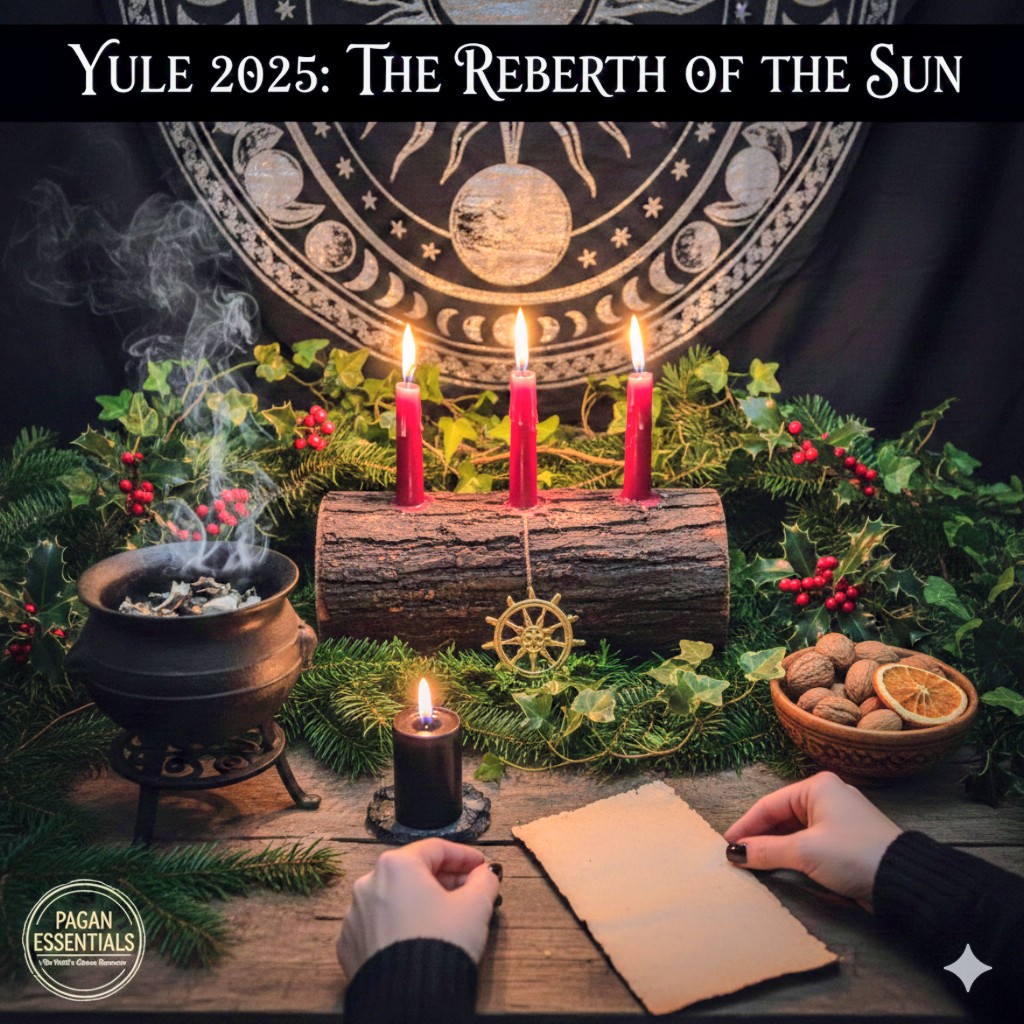
  1. Emphasize Light: Place a central Gold or Yellow candle to represent the newly born Sun. Flank it with red and green candles. If you have a small wooden base, drill three holes and place the candles to create a mini, symbolic Yule Log.
  2. Bring in the Green: Decorate heavily with Evergreensโ€”pine boughs, cedar sprigs, holly, and ivy. These non-dying plants symbolize the promise of eternal life and the resilience of nature in the darkest season.
  3. Natural Offerings: Set out bowls of Nuts (walnuts, hazelnuts) and Seasonal Fruit (oranges, apples, pomegranates). The circle shape of fruit and the hidden potential in nuts beautifully represent the Wheel and the sleeping energy of the Earth.
  4. Solar Symbols: Include items that represent the Sun: a gold disk, sun-shaped ornaments, or a piece of Citrine or Pyrite (Foolโ€™s Gold).
  5. Divination Tools: This is an excellent time for prophecy. Place your Tarot decks, Runes, or Scrying mirror on the altar to ask for guidance for the year ahead.

Yule is a time for joyful celebration and deep, quiet reflection.

  • Burn the Yule Log: This is the most traditional activity. Historically, a log was burned for 12 days. Today, you can use a small log carved with wishes or intentions for the new year. Light it on the Solstice night to help pull the Sun back toward the Earth.
  • Lights, Lights, Lights: Light every candle and string of lights you own! Drive out the symbolic darkness by making your home a beacon of warmth and cheer.
  • Intention Setting: Use the quiet, introspective time of the longest night to reflect on the lessons of the past year and set clear intentions for the waxing year ahead. Write these down.
  • Feasting and Wassailing: Host a Yule Feast with seasonal foods. The tradition of “wassailing” (toasting to health and prosperity) with spiced drinks is a wonderful way to connect with loved ones.
  • Gift Making: Exchange small, handmade gifts infused with magical intent (like a protective charm or a jar spell) rather than mass-produced items.

This ritual is designed to be performed on the night of December 21st to release the darkness and welcome the Sunโ€™s return.

What You’ll Need:

  • Altar Setup: Your prepared Yule altar.
  • Candles: One Black candle (to represent the waning year/darkness) and one Gold/Yellow candle (to represent the reborn Sun/waxing year).
  • Paper & Pen: For writing down what you want to release.
  • Fire-safe dish: a cauldron or metal bowl.
  • Evergreen sprig: Pine or Cedar.

The Ritual Steps:

  1. Preparation and Grounding: Light a bit of cinnamon or pine incense. Take three deep, cleansing breaths. Light your Black Candle first, acknowledging the darkness of the year that is ending.
  2. Release the Dark: Take your paper and pen. Spend a few minutes reflecting on any fears, disappointments, negative habits, or resentments you wish to leave behind in the old year. Write them down one by one.
    • Incantation: Hold the list over the black candle (safely!) and say:”Holly King, Lord of Darkness, thank you for the lessons learned in the waning light. I release these burdens to the longest night.
    • “Carefully and mindfully, place the paper in your fire-safe dish and allow it to burn completely to ash, visualizing the negativity dissolving.
  3. Welcome the Light: Extinguish the Black Candle completely, symbolizing the end of the long night and the darkness you have released. Now, light your Gold/Yellow Candle.
    • Incantation: As you light the Gold Candle, say:”Oak King, Lord of Light, I welcome you! With the Sun’s rebirth, I am reborn. I accept the strength, hope, and warmth you bring. Let the days lengthen and my spirit soar.”
  4. Infuse with Life: Take your Evergreen sprig. Hold it over the flame of the Gold Candle (without touching the flame) and focus on the vitality of the plantโ€”it remains green even in winter. Visualize the Sun’s energy flooding into it.
  5. Affirmation: Place the evergreen sprig on your altar or near a window. Spend a final few minutes in silence, basking in the light of the Gold Candle and feeling the energy of renewal fill you.
  6. Closing: Thank the elements and the spirits of the season. Let the Gold Candle burn down safely or extinguish it when you are ready, knowing the light has returned.

We hope this resource helps you plan a powerful and meaningful Yule celebration! May the returning Sun bring you warmth, abundance, and renewed light in the coming year!

Posted on

๐Ÿ’ซSetting Up Your First Altar: A Guide to Sacred Space Creation

Congratulations, fledgling witch! Taking the step to create your first altar is a profound and exciting moment. An altar isn’t just a decoration; it’s the heart of your personal practiceโ€”a dedicated, sacred space where you connect with the divine, focus your energy, and work your magic.

Don’t worry about needing expensive, fancy tools right away. The most important ingredients are intention, reverence, and personal meaning.

Let’s dive into the practical steps of setting up your very own sacred space.

The location is crucial because it influences the energy of your space.

  • Privacy is Key: Choose a spot where you feel comfortable and won’t be constantly interrupted or scrutinized. This allows you to relax and focus. A quiet corner of your bedroom, a sturdy bookshelf, or a cabinet top works well.
  • A Solid Foundation: The surface should be stable and able to hold your tools safely (especially if you plan on using candles or water).
  • Consider the Directions: In many traditions, the altar is oriented to the North (representing Earth and stability). However, you can also place it in a direction that aligns with your specific intent (e.g., East for new beginnings, West for emotional work).

โœจ Pro-Tip: A small, portable altar in a box or on a tray is an excellent solution for witches who need to keep their practice discreet

Before you place any items, you need to clear the existing energy and consecrate the area.

  • Physical Cleanse: Start with a good old-fashioned cleaning. Dust the surface and wipe it down.
  • Energetic Cleanse: Use a method that resonates with you:
    • * Smudging: Gently wave the smoke of sage, cedar, or palo santo over the area.
    • * Sound: Ring a bell or clap your hands firmly around the space to break up stagnant energy.
    • * Visualization: Imagine a bright, cleansing white or violet light washing over the surface.
    • * Salt Water: Wipe the surface with water that has a pinch of sea salt dissolved in it.

A traditional altar layout often symbolizes the meeting point between the spiritual and physical worlds, usually structured around the four elements (or Quarters):


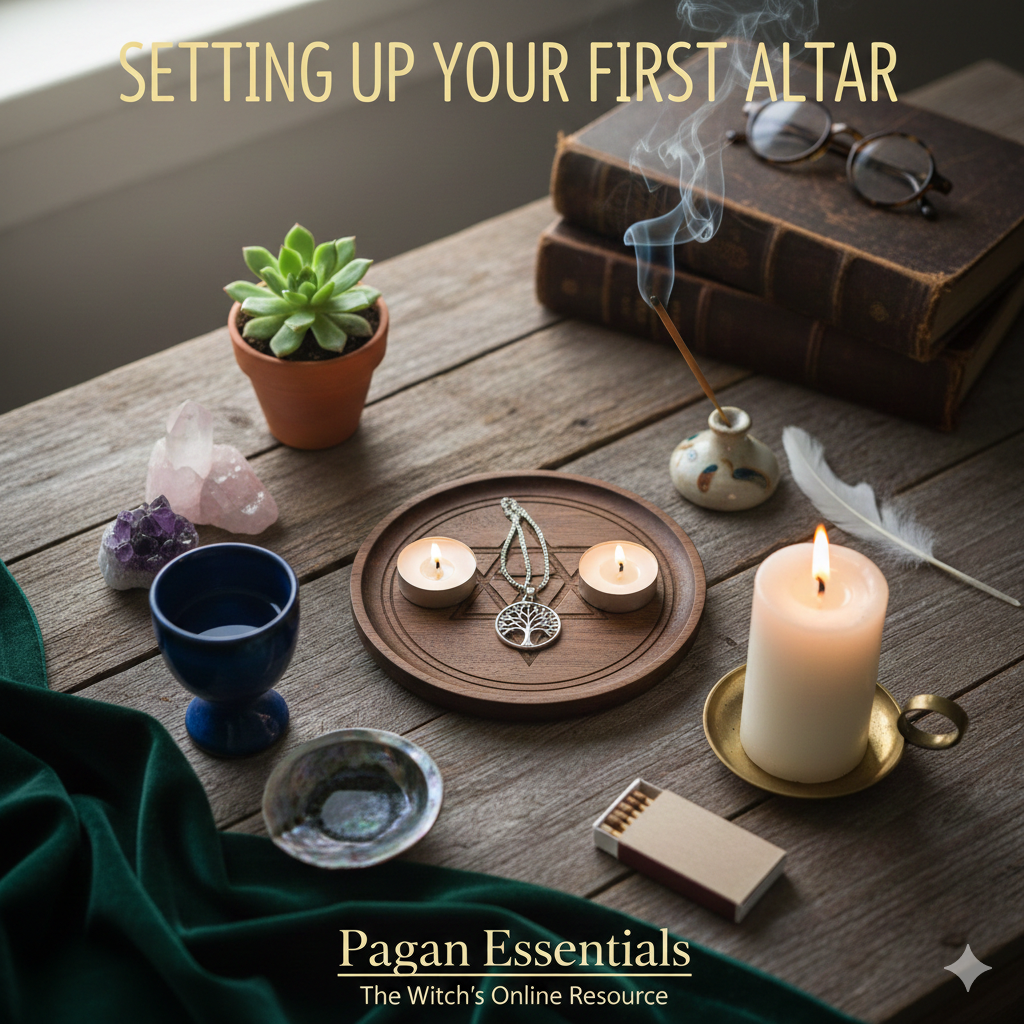
Direction-Element-Altar Placement-Common Tools/Symbols

East-Air-Upper-Right/Front-Incense, Feathers, Wand

South-Fire-Lower-Right/Front-Candles, Lighter/Matches

West-Water-Lower-Left/Back-Chalice, Bowl of Water, Shells

North-Earth-Upper-Left/Back- Crystals, Salt, Pentacles, Plants


In the Center of the altar is where you place the most sacred items, often representing the Divine (God/Goddess) or the Fifth Element: Spirit/Aether. This is also where you’ll usually place your working tools.

You don’t need to buy everything at once! Start with personal, meaningful items.

  • Altar Cloth: A piece of fabric (any color you like!) to protect the surface and define the space.
  • Representations of the Divine: A statue, a picture, a natural object (like a stone or branch), or even two candles (one for the God, one for the Goddess/Divine Feminine/Masculine).
  • Candle: A simple, white candle is perfect for invoking Fire and Spirit. Always use a proper candle holder for safety!
  • Incense Holder & Incense: To represent the element of Air.
  • Chalice or Bowl: A small cup or bowl for Water.
  • Pentacle/Offering Plate: A flat dish, piece of wood, or store-bought pentacle to represent Earth. This is also where you can place offerings or charge smaller items.
  • Personal Items: A meaningful crystal, a favorite piece of jewelry, a leaf you found on a walkโ€”items that make the space feel uniquely yours.

Once everything is placed, take a moment to stand before your altar and feel the energy.

  1. Light your candle and incense.
  2. State your intention for the altar out loud (e.g., “I dedicate this space to my highest spiritual growth and magical practice”).
  3. Perform a simple centering or grounding exercise.
  4. Touch each object, reinforcing its purpose and meaning to you.

Your altar is now active! It is a place of power, reflection, and transformation. Use it often. The more you interact with it, the stronger its energy will become.

What’s Next?

Don’t be afraid to change your altar as your practice evolves or with the changing seasons!

Do you have questions about specific altar tools like the Athame or Boline? Let me know what you’d like to learn about next!

Posted on 2 Comments

๐Ÿงน Starting Your Journey: Essential Tools for the New Witch (and What You Really Need)

Welcome, fledgling witch! Taking your first steps on this path is an exciting and sometimes overwhelming experience. You might be scrolling through beautiful photos of elaborate altars and feeling like you need to spend a fortune on crystal balls and fancy athames just to get started.

โ€‹Stop right there.

โ€‹The most powerful tool in your practice is you. Your intention, your intuition, and your focused will are always enough.

โ€‹At Pagan Essentials, we believe your practice should be accessible and affordable. Here is a guide to the tools often mentioned in witchcraft, and what you can use instead (or skip entirely!) when you’re just starting out.

โ€‹I. The “Essential” Tools (and the Practical Alternatives)

โ€‹These are the items you’ll see in most books, but you don’t need the specialized, expensive versions.

  • โ€‹Traditional Purpose: These are directing tools. They are used to channel and direct energy, cast a circle, and point to focus intention. They are rarely used for actual cutting.
  • โ€‹The Myth: You need a beautifully carved wand or a dagger with a specific handle.
  • โ€‹The Practical Alternative:
    • โ€‹Your Finger: Yes, simply point! Your hand is an incredible natural conduit for energy.
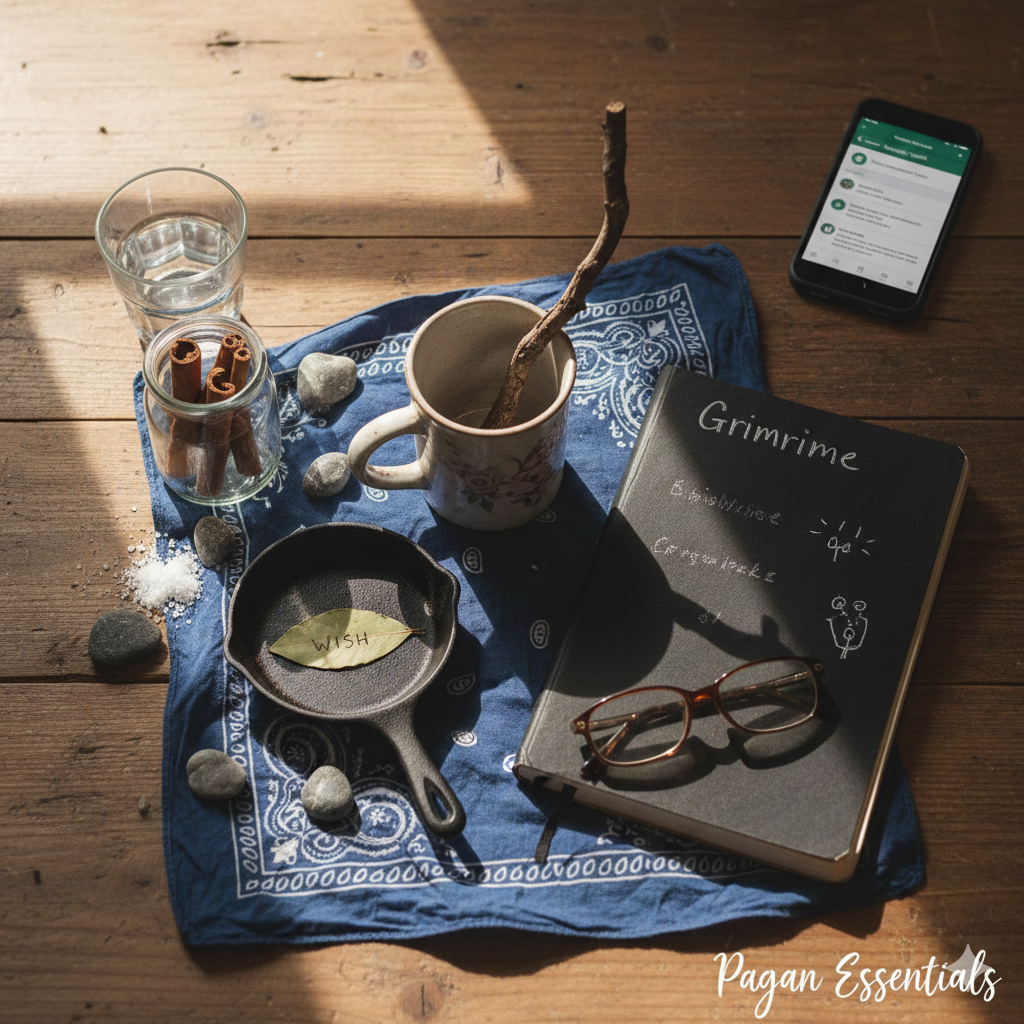
    • โ€‹A Stick: Find a beautiful, fallen branch on a nature walk. Cleanse it and you have a perfect, personalized wand.
    • โ€‹A Pencil: A new pencil (unsharpened or sharpened) can be ritually dedicated as your energy directing tool.
  • โ€‹Traditional Purpose: Holding objects for scrying, making herbal infusions, burning petition papers, or containing ingredients. It represents the element of water and the womb of the Goddess.
  • โ€‹The Myth: It must be a heavy, cast-iron pot with three legs.
  • โ€‹The Practical Alternative:
    • โ€‹Any Heat-Safe Bowl or Mug: An old ceramic mug or a small, thrifted cast-iron skillet (often $5 or less) works perfectly.
    • โ€‹A Large Sea Shell: If you only need to contain small items or hold water for a scrying mirror.
  • โ€‹Traditional Purpose: To define a dedicated, clean, and sacred space for ritual work.
  • โ€‹The Myth: You need expensive, silk fabric embroidered with complex symbols.
  • โ€‹The Practical Alternative:
    • โ€‹A Scarf or Bandana: Use an old scarf you love, or buy a $1 bandana from a craft or dollar store. The color can even correspond to your current magical work.
    • โ€‹A Clean Napkin or Hand Towel: If you don’t have a permanent altar, just laying down a clean, dedicated piece of fabric on a clear shelf or table defines your workspace just as effectively.

โ€‹II. The No-Tool Practice: What You Really Need

โ€‹If you have a zero-dollar budget, you can still practice effectively. Remember, witchcraft is about energy, visualization, and intention.

Tool (or Need)/Zero-Cost Alternative/How to Use It

  • Candles/(Light Source) Sunlight, Moonlight, or Visualization/For charging and cleansing, place items in a windowsill. /F))or ritual, visualize a strong, white light surrounding you or filling an object with energy.
  • Incense (Aroma/Air) /Fresh Air or Deep/ Breathing Open a window for a breath of fresh air, or simply focus on your breath. Your breath is the purest form of the element of Air.
  • Crystals (Energy/Grounding) Stones from the Garden or Park/ Find a naturally smooth or interesting rock while walking. /Cleanse it and hold it during meditation for grounding. Always be safe and respectful when taking from nature.
  • .Herbs (Intention/Spells) Kitchen Spices-
  • Bay leaves (for wishes),
  • salt (for cleansing /protection),
  • cinnamon (for success/prosperity), or even coffee grounds (for speed/grounding).
  • Gfimoire/ Book of Shadows~ Your Phone’s Notes App or a Composition Notebook

Take a deep breath, ground yourself, and begin. Your magic is ready when you are.

โ€‹

Posted on 2 Comments

Protection Magick: Shielding Yourself and Your Space from Negative Energies

Welcome, dear readers, to Pagan Essentials! Today, we’re delving into a cornerstone of magickal practice: protection. In a world brimming with diverse energies, knowing how to shield yourself and your sacred space is not just beneficial, but essential.

โ€‹Think of protection magick as creating an energetic boundary โ€“ a spiritual immune system that keeps out what doesn’t serve you and allows in only what nurtures your growth. It’s about empowering yourself to navigate life with confidence, knowing you have a shield against negativity, psychic attacks, and unwelcome influences.

Just as you lock your doors at night or wear a coat in the cold, energetic protection is a sensible precaution. We interact with countless energies daily, from the emotions of others to ambient spiritual currents. Without protection, you can become an energetic sponge, absorbing negativity that can manifest as fatigue, irritability, bad luck, or even illness. Protection magick helps you:

  • Maintain your energetic integrity: Keep your own energy vibrant and uncompromised.
  • Prevent psychic vampirism: Shield yourself from those who unknowingly (or knowingly) drain your energy.
  • Create sacred space: Ensure your home and personal areas remain sanctuaries of peace.
  • Enhance your spell work: Work more effectively without interference.

There are many ways to approach protection, and the most effective methods are often those that resonate deeply with you. Here are some fundamental pillars:

โ€‹1. Cleansing & Purification:

Before you can protect, you must purify. Think of it like cleaning a surface before applying a protective sealant. Regular cleansing removes stagnant or negative energies that have accumulated.

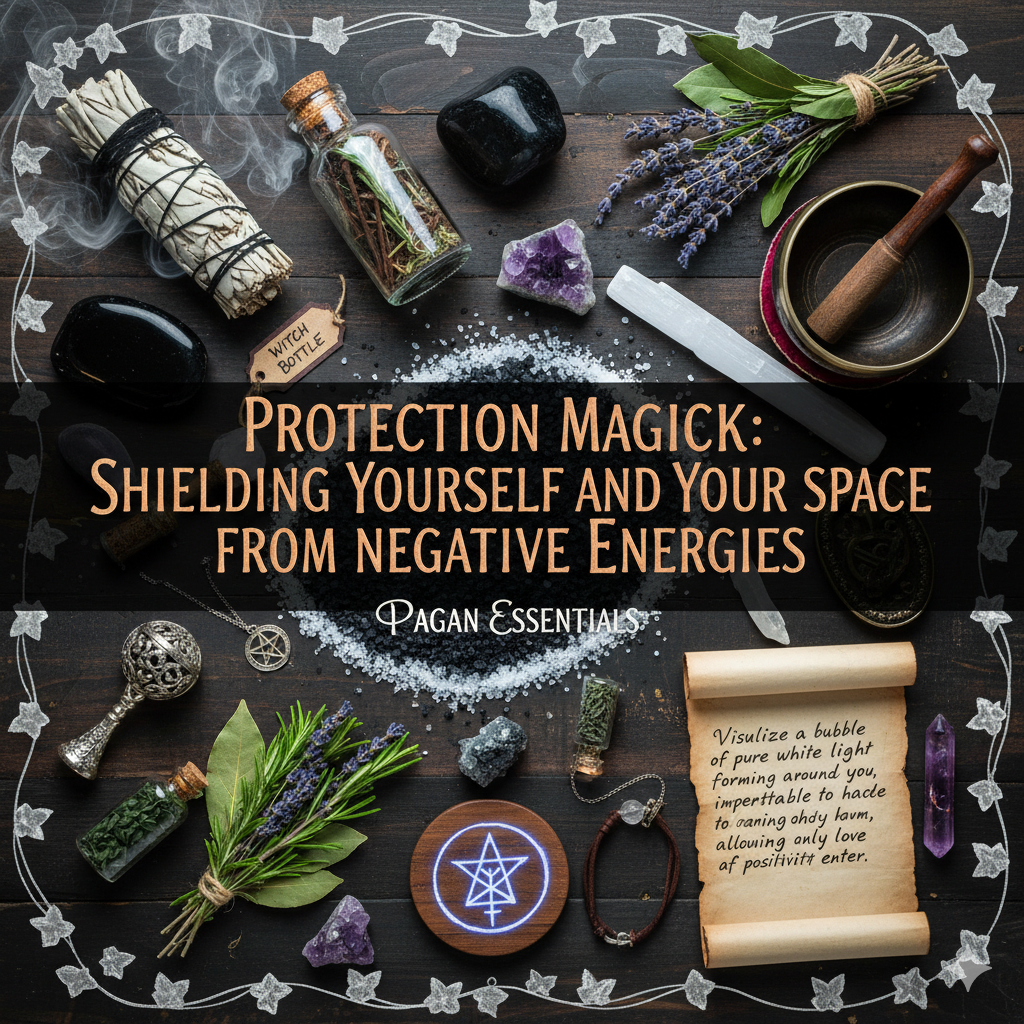
  • โ€‹Smudging: Using sacred smoke from herbs like sage, palo santo, or cedar.
  • โ€‹Salt: Sprinkling sea salt, black salt, or using salt lamps.
  • โ€‹Sound: Bells, chimes, singing bowls, or even clapping can break up energetic stagnation.
  • โ€‹Herbal Washes: Bathing in water infused with protective herbs like rosemary or rue.

โ€‹2. Wards & Barriers:

These are deliberate energetic structures or physical objects placed to deter unwanted influences.

  • โ€‹Salt Barriers: A line of salt across doorways and windows.
  • โ€‹Witch Bottles: Jars filled with sharp objects (nails, pins), protective herbs, and personal items, buried near the property line or placed in a hidden spot.
  • โ€‹Sigils & Runes: Drawing protective symbols on doorways, windows, or charging them onto objects.
  • โ€‹Crystals: Black tourmaline, obsidian, amethyst, and selenite are excellent for protection. Place them in corners of rooms or carry them with you.

โ€‹3. Personal Shielding:

This is about creating a protective energy field around yourself. It’s a fundamental daily practice for many witches.

  • โ€‹Visualization: Imagine a bubble of white light, an impenetrable mirror, or a cloak of protective energy surrounding you. Affirm that only positive, beneficial energies can enter.

Posted on 3 Comments

โœจ Embracing the Void: An Introduction to Chaos Magick

Hello, seekers! Welcome back to Pagan Essentials. Today, we’re diving into one of the most dynamic, paradigm-bending, and controversial paths in modern occultism: Chaos Magick.If you.’re used to traditional paths with ancient pantheons, strict rituals, and establishe n,cosmologies, prepare to have your mind pleasantly scrambled. Chaos Ma. Ingick (often shortened to “Chaotes” or “CM”) is less a system and more an attitudeโ€”a rebellious, practical, and highly effective approach to magical practice.

Chaos Magick emerged in the 1970s in England, primarily influenced by artists, occultists like Austin Osman Spare, and the counter-cultural spirit of the time. It is fundamentally defined by one core principle:The belief is the tool, not the truth.In traditional magick, you might follow a system (like Wicca, Golden Dawn, or Hermeticism) because you believe its underlying cosmology and deities are real and true.

In Chaos Magick, you temporarily adopt a belief systemโ€”a paradigmโ€”because it is useful for achieving a specific magical goal. Once the goal is achieved, you drop the paradigm like a hot potato.

This is famously summarized by the phrase: “Nothing is True; Everything is Permitted.”

  • Paradigm Shifting: The ability to effortlessly step into and out of different belief systems. One day you might be working with Cthulhu, the next with a Christian saint, and the day after with quantum physicsโ€”whatever works for the desired effect.
  • Gnosis (Altered State of Consciousness): All effective magick is achieved in a state of deep focus, often called Gnosis. This is the moment when the conscious, critical mind is bypassed, allowing the magical intention to be impressed upon the subconscious.
  • Inhibitory Gnosis: Achieved through deep meditation, trance, boredom, or yoga.
  • Excitory Gnosis: Achieved through intense chanting, dancing, drumming, sensory overload, or even sex.Practicality First: If it works, use it. If it doesn’t, discard it. Chaos Magick is deeply results-oriented.
  • โ€‹Excitory Gnosis: Achieved through intense chanting, dancing, drumming, sensory overload, or even sex.
  • โ€‹Practicality First: If it works, use it. If it doesn’t, discard it. Chaos Magick is deeply results-oriented.

If Chaos Magick has a single, defining ritual, it is the practice of Sigilization. It’s elegant, simple, and incredibly potent.

A sigil is a symbol created to bypass the conscious mind, which often second-guesses or dilutes magical intent.

  1. Formulate Your Intent: Write down your desire clearly and concisely. It must be stated in the present tense, as if it has already happened. Example: “I desire to receive a new creative opportunity.”
  2. Condense the Letter mms: Remove all repeating letters from your sentence.Example: I D S R E C V A N W T O P Y U (all unique letters)
  3. Design the Symbol: Arrange and stylize these remaining letters into a single, compact, abstract monogram. Make it unrecognizable as the original sentence.
  4. Charge the Sigil: This is where Gnosis comes in. Stare at the sigil until you are in a trance-like state, then deliberately forget what the sigil was designed for.
  5. โ€‹Release and Forget: The most crucial step! Your conscious mind must forget the sigil’s purpose. Burn it, tear it up, bury it, or toss it into a lake. This ‘launches’ the desire into your subconscious.: “desire to receive a new creative opportunity.

While the freedom of Chaos Magick is liberating, it demands a high degree of personal responsibility and psychological health.

Since you are constantly manipulating your own beliefs, it’s vital to maintain a sense of objective reality. Chaotes must be acutely aware of their own psychological mechanisms to avoid getting trapped in a temporary paradigm or suffering a spiritual crisis. The path is for the intellectually curious and the magically daring.

Chaos Magick is an excellent path if you:

  • Feel constrained by the rules of traditional systems.
  • Are interested in results over dogma.
  • Have a background in philosophy, science, or art (it helps!).
  • โ€‹๐Ÿ›‘ Caution: The Shadow Side of Freedom

Example: “I desire to receive a new creative opportunity.”