Pagan Essentials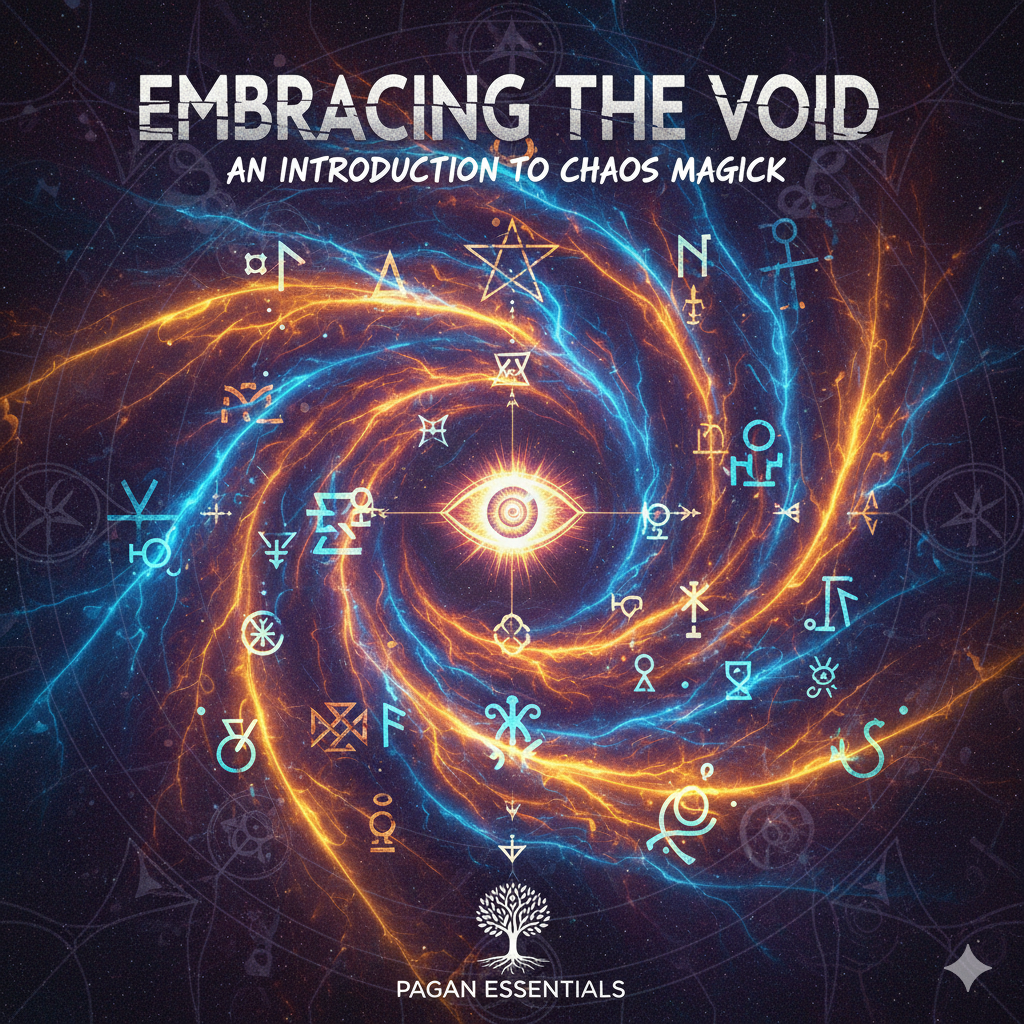
Hello, seekers! Welcome back to Pagan Essentials. Today, we’re diving into one of the most dynamic, paradigm-bending, and controversial paths in modern occultism: Chaos Magick.If you.’re used to traditional paths with ancient pantheons, strict rituals, and establishe n,cosmologies, prepare to have your mind pleasantly scrambled. Chaos Ma. Ingick (often shortened to “Chaotes” or “CM”) is less a system and more an attitude—a rebellious, practical, and highly effective approach to magical practice.
🌀 What is Chaos Magick? The Core Philosophy
Chaos Magick emerged in the 1970s in England, primarily influenced by artists, occultists like Austin Osman Spare, and the counter-cultural spirit of the time. It is fundamentally defined by one core principle:The belief is the tool, not the truth.In traditional magick, you might follow a system (like Wicca, Golden Dawn, or Hermeticism) because you believe its underlying cosmology and deities are real and true.
In Chaos Magick, you temporarily adopt a belief system—a paradigm—because it is useful for achieving a specific magical goal. Once the goal is achieved, you drop the paradigm like a hot potato.
This is famously summarized by the phrase: “Nothing is True; Everything is Permitted.”
Key Concepts of the Chaote Path
- Paradigm Shifting: The ability to effortlessly step into and out of different belief systems. One day you might be working with Cthulhu, the next with a Christian saint, and the day after with quantum physics—whatever works for the desired effect.
- Gnosis (Altered State of Consciousness): All effective magick is achieved in a state of deep focus, often called Gnosis. This is the moment when the conscious, critical mind is bypassed, allowing the magical intention to be impressed upon the subconscious.
- Inhibitory Gnosis: Achieved through deep meditation, trance, boredom, or yoga.
- Excitory Gnosis: Achieved through intense chanting, dancing, drumming, sensory overload, or even sex.Practicality First: If it works, use it. If it doesn’t, discard it. Chaos Magick is deeply results-oriented.
- Paradigm Shifting: The ability to effortlessly step into and out of different belief systems. One day you might be working with Cthulhu, the next with a Christian saint, and the day after with quantum physics—whatever works for the desired effect.
- Gnosis (Altered State of Consciousness): All effective magick is achieved in a state of deep focus, often called Gnosis. This is the moment when the conscious, critical mind is bypassed, allowing the magical intention to be impressed upon the subconscious.
- Inhibitory Gnosis: Achieved through deep meditation, trance, boredom, or yoga.
- Excitory Gnosis: Achieved through intense chanting, dancing, drumming, sensory overload, or even sex.
- Practicality First: If it works, use it. If it doesn’t, discard it. Chaos Magick is deeply results-oriented.
✍️ The Signature Technique: Sigilization
If Chaos Magick has a single, defining ritual, it is the practice of Sigilization. It’s elegant, simple, and incredibly potent.
A sigil is a symbol created to bypass the conscious mind, which often second-guesses or dilutes magical intent.
How to Create a Sigil (The Austin Osman Spare Method)
- Formulate Your Intent: Write down your desire clearly and concisely. It must be stated in the present tense, as if it has already happened. Example: “I desire to receive a new creative opportunity.”
- Condense the Letter mms: Remove all repeating letters from your sentence.Example: I D S R E C V A N W T O P Y U (all unique letters)
- Design the Symbol: Arrange and stylize these remaining letters into a single, compact, abstract monogram. Make it unrecognizable as the original sentence.
- Charge the Sigil: This is where Gnosis comes in. Stare at the sigil until you are in a trance-like state, then deliberately forget what the sigil was designed for.
- Release and Forget: The most crucial step! Your conscious mind must forget the sigil’s purpose. Burn it, tear it up, bury it, or toss it into a lake. This ‘launches’ the desire into your subconscious.: “desire to receive a new creative opportunity.“
🛑 Caution: The Shadow Side of Freedom
While the freedom of Chaos Magick is liberating, it demands a high degree of personal responsibility and psychological health.
Since you are constantly manipulating your own beliefs, it’s vital to maintain a sense of objective reality. Chaotes must be acutely aware of their own psychological mechanisms to avoid getting trapped in a temporary paradigm or suffering a spiritual crisis. The path is for the intellectually curious and the magically daring.
🔮 Is Chaos Magick for You?
Chaos Magick is an excellent path if you:
- Feel constrained by the rules of traditional systems.
- Are interested in results over dogma.
- Have a background in philosophy, science, or art (it helps!).
- 🛑 Caution: The Shadow Side of Freedom
Example: “I desire to receive a new creative opportunity.”