Posted on

Book of Shadows vs. Grimoire: What’s the Difference?

​By Ivyjaded Wyldfyre

Greetings, fellow travelers on the magical path! Today, let’s delve into a topic that often sparks curiosity and sometimes a little confusion: the difference between a Book of Shadows and a Grimoire. While both are invaluable tools for any witch or pagan, they serve distinct purposes in our craft.

The Book of Shadows: Your Personal Magical Journal

Think of your Book of Shadows (BOS) as your most intimate magical companion – a personal journal of your spiritual journey and magical practice. It’s a living, breathing record of your experiences, insights, and growth.

What goes into a Book of Shadows?

  • Spells and Rituals: Not just any spells, but those you have personally worked, adapted, or created. Include details about the moon phase, time of day, your emotional state, and the results. Did it work? What would you change next time?
  • Correspondences: Your personal notes on herbs, crystals, colors, deities, astrological alignments, and their magical associations. This is tailored to your understanding and experience.
  • Divination Records: Keep track of your tarot readings, pendulum sessions, or other divinatory practices. What questions did you ask? What answers did you receive? How did they resonate?
  • Dreams and Visions: A space to record your dreams, particularly those that feel significant or carry magical messages.
  • Meditations and Reflections: Your thoughts, feelings, and insights gained during meditation, sabbat celebrations, or moments of spiritual clarity.
  • Recipes: Magical concoctions, incense blends, oils, and even recipes for pagan feasts.
  • Poetry, Art, and Sigils: Any creative expressions inspired by your practice.

​The BOS is deeply personal and often kept private. It’s a reflection of your unique path and evolves with you over time. There’s no right or wrong way to create one; it can be a simple notebook, a beautifully bound tome, or even a digital file. The most important thing is that it serves you.

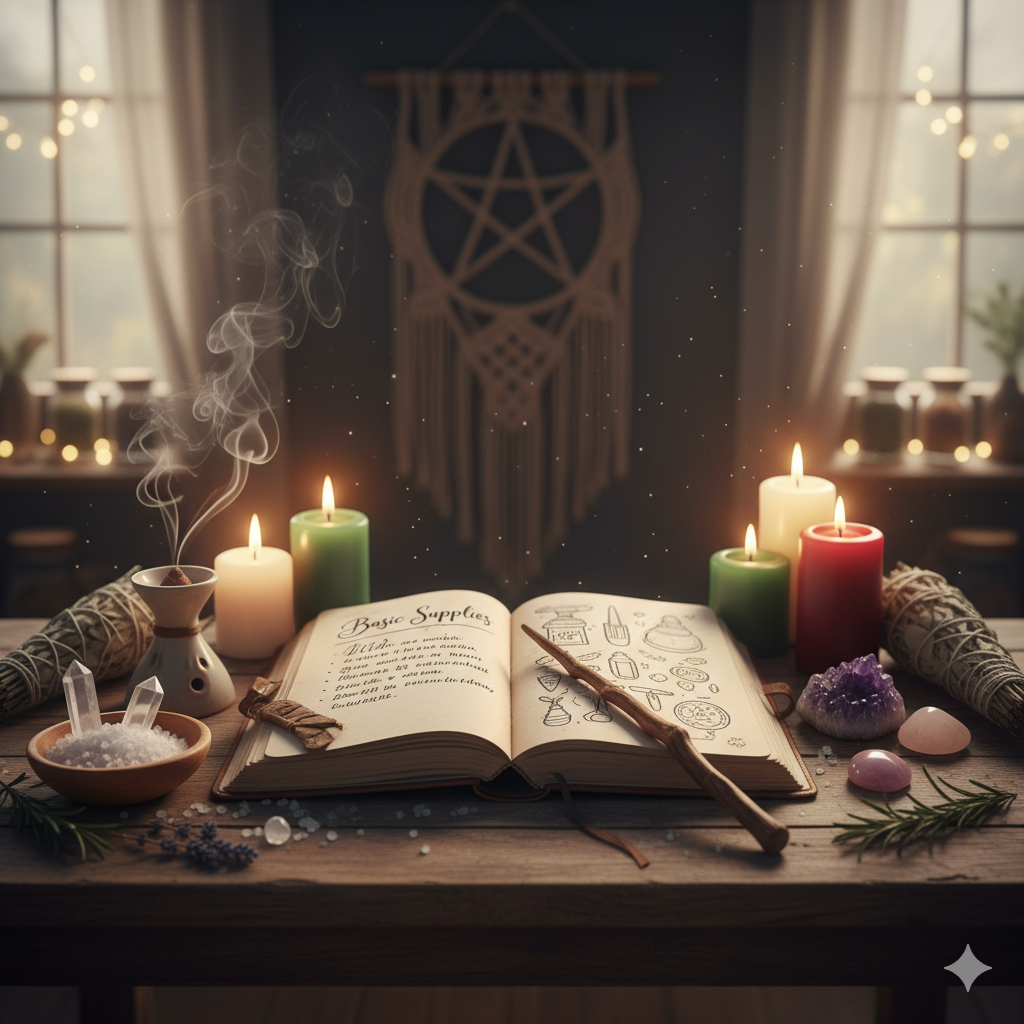
​Here’s an example of what a beautifully adorned Book of Shadows might look like, perhaps open to a page with a new moon spell:

Book of Shadows

The Grimoire: A Comprehensive Magical Reference

A Grimoire, on the other hand, is more akin to a textbook or a reference manual for magical practices. While it can also be personal, its primary purpose is to compile information, spells, rituals, and magical knowledge that can be accessed and utilized by others, or as a structured resource for your own learning.

What goes into a Grimoire?

  • Established Spells and Rituals: These are often spells passed down through traditions, sourced from books, or widely known within a specific magical system. Think of classic protection spells or traditional ceremonial magic rituals.
  • Magical Theory: Explanations of magical principles, laws, and philosophies.
  • Divine Names and Invocations: Lists of deities, spirits, or entities, along with their sigils, symbols, and appropriate invocations.
  • Astrology and Numerology Charts: Detailed information on planetary hours, zodiac correspondences, and numerological meanings.
  • Herbal and Crystal Encyclopedias: Comprehensive lists of magical properties, uses, and preparation methods for various herbs and crystals.
  • Symbolism and Sigils: Meanings of various magical symbols, runic alphabets, ogham, or other magical scripts.
  • Consecration and Preparation: Instructions for consecrating tools, creating sacred space, and preparing for magical work.

​Grimoires tend to be more organized and structured than a BOS. They are often less about personal experience and more about documented magical knowledge. Many historical grimoires, like the Key of Solomon, are famous examples of this type of text. Some witches keep both – a BOS for their personal journey and a Grimoire for a more formalized collection of magical lore.

​Imagine a section of a Grimoire dedicated to various symbols and their meanings, beautifully illustrated for easy reference.

Grimoire

Can You Have Both? Absolutely!

Many practitioners find immense value in keeping both a Book of Shadows and a Grimoire. Your BOS becomes the place where you experiment, grow, and reflect, while your Grimoire serves as a solid foundation of magical wisdom to draw upon. Some even start with a general Grimoire and then gradually personalize sections into their BOS.

​Ultimately, the best approach is the one that resonates most with you and supports your unique magical journey. Whether you choose one, both, or something entirely different, the act of documenting your craft is a powerful magical act in itself.

​Blessed be, and may your pages be ever filled with wisdom and wonder!

About Ivyjaded Wyldfyre: Ivyjaded is a green witch, avid herbalist, and lover of ancient lore. She believes in finding magic in the everyday and connecting deeply with the natural world. When not tending her herb garden or brewing potions, she can be found lost in a good book or exploring forgotten forest paths.

Posted on

Mabon: A Time of Harvest and Balance

By Ivyjaded Wyldfyre  at Pagan Essentials

As the Wheel of the Year turns, we arrive at Mabon, the Autumn Equinox, a time of balance, gratitude, and the second harvest. For those of us in the Northern Hemisphere, this Sabbat marks the official start of autumn, when day and night stand in perfect equilibrium before the nights begin to lengthen.

When is Mabon 2025?

In 2025, Mabon in the Northern Hemisphere will occur on Monday, September 22nd.

The History of Mabon

While the name “Mabon” itself is a modern invention coined by Aidan Kelly in the 1970s, the celebration of the Autumn Equinox is ancient and deeply rooted in agricultural societies. Across various cultures, this time of year has always been dedicated to giving thanks for the bounty of the harvest, preparing for the colder months ahead, and acknowledging the changing seasons. It was a time of feasting, community gathering, and honoring the generous Earth.

Correspondences of Mabon

​Mabon is rich with symbolic correspondences that reflect its themes of harvest, balance, and gratitude.

  • Colors: Red, orange, yellow, brown, gold, deep greens, maroon.
  • Symbols: Cornucopia, baskets, sickles, acorns, pinecones, leaves, grapes, apples, pomegranates, squash, pumpkins, gourds, wine, bread.
  • Deities: Mabon Ap Modron (Welsh God of Light), Persephone, Demeter, John Barleycorn, Dionysus, Ceres, Inanna, Modron.
  • Herbs & Plants: Mugwort, rue, sage, yarrow, rosemary, frankincense, myrrh, oak, hazel, pine, cypress, cedar.
  • Crystals: Sapphire, amber, citrine, aventurine, carnelian, jasper, topaz, Lapis lazuli, agate, tiger’s eye
  • Animals: Deer, owl, wolf, bear, salmon.
  • Themes: Gratitude, balance, reflection, harvesting, abundance, protection, preparation, letting go, equality.

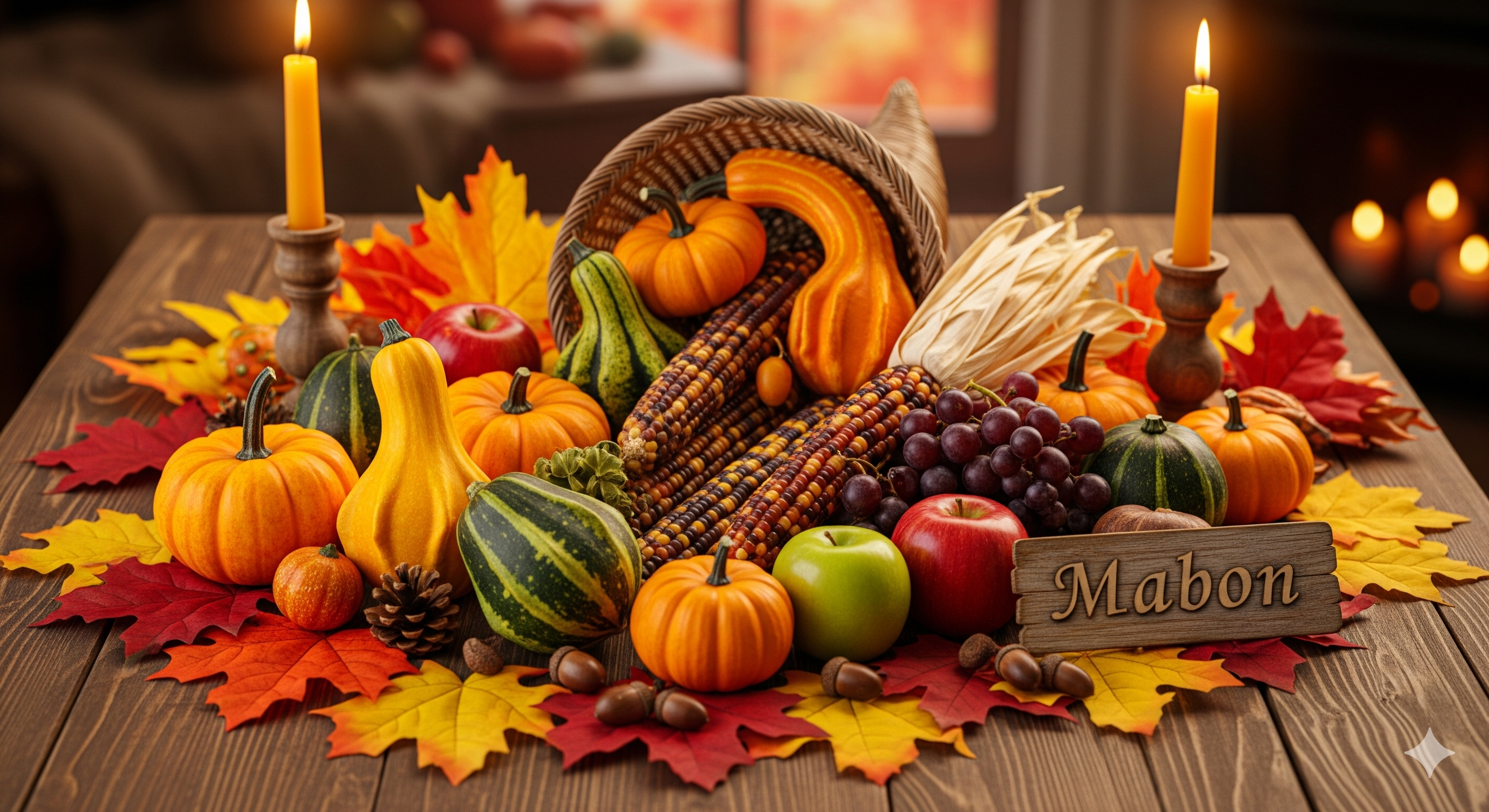
An Example Mabon Altar

Creating a Mabon altar is a wonderful way to honor the Sabbat and bring its energy into your home. Here’s an idea for inspiration:

Set out a rich, autumnal-colored cloth, perhaps in deep red or orange. In the center, place a cornucopia overflowing with small gourds, miniature pumpkins, apples, and ears of corn. Add candles in colors like gold, brown, or deep green. You might include representations of deities associated with Mabon, such as a statue of Demeter or a symbol of the Horned God. Scatter fallen leaves, acorns, and pinecones around the base. Include any crystals that resonate with Mabon’s energy, and perhaps a small chalice for offerings of cider or wine.

Mabon Activities to Participate In

There are many ways to celebrate Mabon and connect with its energies:

  1. Harvesting & Foraging: If possible, gather late-season herbs, fruits, or nuts. Even a trip to a local apple orchard or pumpkin patch can be a wonderful way to connect with the harvest.
  2. Feasting: Prepare a special meal using seasonal ingredients like apples, squash, corn, and root vegetables. Share it with loved ones as an act of gratitude for abundance.
  3. Nature Walks: Spend time in nature, observing the changing leaves and feeling the shift in the air. Collect fallen leaves, acorns, and other natural treasures.
  4. Autumn Decorating: Adorn your home with natural elements like gourds, pumpkins, dried corn, and colorful leaves.
  5. Gratitude Practice: Take time to reflect on the blessings and harvests in your life, both tangible and intangible. Keep a gratitude journal.
  6. Canning & Preserving: Engage in the traditional act of preserving food for the winter months, symbolizing preparation and self-sufficiency.
  7. Sabbat Cleaning: Just as nature is letting go, consider decluttering and cleansing your home to make space for new energies.
  8. Baking: Bake apple pies, pumpkin bread, or corn muffins as offerings or to share.

An Example Mabon Ritual: A Simple Gratitude Offering

This simple ritual can be performed alone or with others.

Supplies Needed:

  • ​A small piece of bread (homemade if possible)
  • ​A cup of cider, wine, or water
  • ​A quiet space, preferably outdoors or near your altar
  • A candle (optional)

The Ritual:

  1. Center Yourself: Find a comfortable position. Take a few deep breaths, grounding yourself to the Earth. If using a candle, light it now.
  2. Acknowledge the Season: Say aloud: “The wheel turns, and day and night stand in perfect balance. We welcome Mabon, the time of the second harvest, a moment of gratitude and reflection.”
  3. Offer the Bread: Hold the piece of bread in your hands. Reflect on the bounty it represents – the sun, rain, earth, and labor that brought it forth. Say: “For the gifts of the Earth, for the abundance in my life, for the nourishment of body and spirit, I am thankful.” Break off a piece and place it outside (if safe for wildlife) or on your altar as an offering.
  4. Offer the Drink: Hold the cup. Reflect on the sustenance and joy it brings. Say: “For the flowing waters, for the fruits of the vine, for health and vitality, I give thanks.” Pour a small amount outside or on your altar.
  5. Personal Gratitude: Take a moment to silently or audibly list specific things you are grateful for in your life right now.
  6. Release and Balance: Acknowledge the balance of Mabon. Say: “As light and dark find equilibrium, I seek balance within myself. I release what no longer serves me and embrace the wisdom of the changing seasons.”
  7. Closing: Thank the spirits of the season, your guides, or the divine as you understand them. Take a final deep breath. If you lit a candle, safely extinguish it.

May your Mabon be filled with abundance, gratitude, and perfect balance!

Do you have any specific Mabon traditions you’d like to share, or would you like to see an image of a Mabon altar?

Mabon Altar
Posted on 1 Comment

How Do I Start? Resources for New Witches: A Step-by-Step Guide

Welcome, curious soul, to the path of witchcraft! If you’re feeling drawn to the ancient wisdom, the power of nature, and the magic within, you’ve come to the right place. The journey into witchcraft is deeply personal and incredibly rewarding. Here at Pagan Essentials, we’re thrilled to offer you a starting point. Let’s dive in!

The very first step on any magical path is to simply explore. There’s no single “right” way to be a witch, and the vastness of traditions and practices can be exciting!

  • Read, Read, Read: Immerse yourself in different perspectives. Start with general introductions to witchcraft, then delve into specific traditions that pique your interest, such as Wicca, Traditional Witchcraft, Green Witchcraft, or Chaos Magic.
  • Listen and Learn: Podcasts, documentaries, and reputable online articles can be excellent resources.
  • Keep a Journal: As you explore, jot down your thoughts, feelings, and any concepts that resonate with you. This will become an invaluable tool on your journey.
  • ​”Wicca: A Guide for the Solitary Practitioner” by Scott Cunningham (a classic, though focused on Wicca)
  • ​”Psychic Witch: A Metaphysical Guide to Meditation, Magick & Manifestation” by Mat Auryn
  • ​”Protection & Reversal Magick” by Jason Miller
  • ​”The Inner Temple of Witchcraft” by Christopher Penczak (comprehensive and great for structured learning)

Before you cast a single spell or invoke a deity, mastering grounding and meditation is crucial. These practices will help you center yourself, manage your energy, and connect with your inner wisdom.

  • Grounding: Think of grounding as rooting yourself to the Earth, like a tree. It helps dissipate excess energy, brings you into the present moment, and provides stability. There are many techniques, but a simple one is to visualize roots extending from the soles of your feet deep into the Earth, drawing up its calm, stable energy.
  • Meditation: This isn’t about emptying your mind, but rather observing your thoughts without judgment and focusing your awareness. Start with just 5-10 minutes a day, focusing on your breath. Meditation enhances intuition, concentration, and psychic abilities – all vital for magical work.

Magic is powerful, and with great power comes great responsibility. Before engaging in any spell work, it’s essential to consider the ethical implications.

  • The Threefold Law/Rule of Return: Many traditions adhere to the idea that whatever energy you send out (positive or negative) will return to you threefold. While not universally adopted, it’s a valuable reminder to act with intention and integrity.
  • Do No Harm: This is a fundamental principle for many witches. Consider the potential impact of your actions on yourself, others, and the environment.
  • Consent: Never attempt to influence someone’s free will without their explicit consent. This includes love spells, mind manipulation, or any form of coercive magic.
  • Personal Responsibility: You are accountable for your magic. Take time to reflect on your intentions and the potential consequences of your workings.

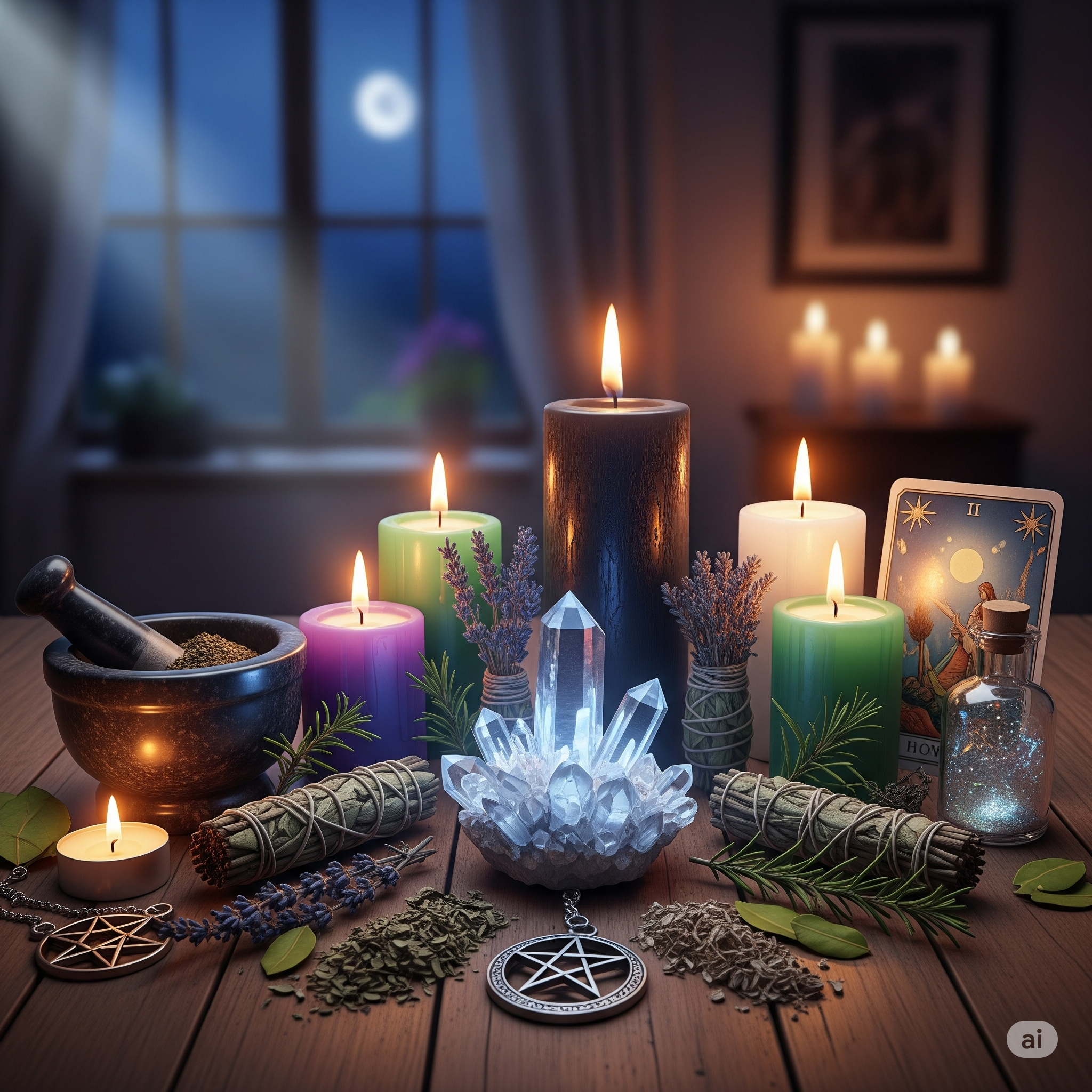
​You don’t need anything to be a witch – your most potent tools are your mind and spirit. However, certain items can enhance your practice and create a sacred atmosphere.

  • Journal/Book of Shadows: A place to record your spells, rituals, dreams, and magical insights.
  • Candles: Different colors correspond to different intentions (e.g., white for purity, green for prosperity, red for passion).
  • Incense/Herbs: For cleansing, offering, or setting the mood. Sage, palo santo, and frankincense are popular choices.
  • Salt: A powerful purifier and protector.
  • Wand or Athame: (Optional) These are tools to direct energy, not for cutting. A simple stick found in nature can serve as a powerful wand!
  • Altar Space: A dedicated area, no matter how small, to honor your practice. It can hold your tools, natural items, and representations of what you hold sacred.
  • Crystals: Each crystal carries unique energetic properties. Start with clear quartz, amethyst, or rose quartz for general purposes.

Posted on 1 Comment

Raising Energy for Spellwork

Welcome, fellow seekers, to Pagan Essentials, where we delve into the heart of magical practice. One of the most fundamental skills for any witch is the ability to raise, direct, and release energy for spellwork. Without a concentrated burst of power, even the most beautifully crafted spell can fall flat.

​Think of it like charging a battery before you use it. Your own power is the most potent tool in your arsenal, and learning to build it up is key to successful magical work. Whether you’re a solitary practitioner or part of a coven, there are countless ways to get your energy flowing.

Here are some of the most effective techniques for raising power before you cast:

Physical and Emotional Techniques

Energy isn’t just a mental construct; it’s a very real force that can be felt and moved with your body.

  • Chanting and Rhythm: Repetitive sound is a powerful tool. Chanting an incantation, mantra, or simple phrase can build a palpable vibration in your body and your space. Adding a drum or clapping your hands can intensify this effect.
  • Movement and Dance: Dancing, spinning, or even just bouncing in place can help stir up your inner energy. Don’t worry about looking graceful—this is about feeling the power build within you.
  • Stirring Emotion: Emotions like passion, joy, anger, or deep love are raw energy. Tapping into an intense emotion that aligns with your spell’s intention can provide a huge boost of power.
  • Sexual Energy: Often considered one of the most powerful forms of energy, sexual energy can be channeled and directed into spellwork. The moment of orgasm can be used to release and send your intention with incredible force.

Mental and Spiritual Techniques

​A strong mind is a witch’s greatest ally. These techniques focus on internal work to generate power.

  • Grounding and Centering: Before you begin, connect to the Earth (grounding) and find your internal balance (centering). This prevents you from becoming overwhelmed and provides a stable foundation from which to draw power. Visualize roots extending from your feet into the earth, anchoring you.
  • Visualization: This is the act of seeing your intention manifest. Visualize energy as a swirling ball of light or a flowing river, gathering within you or between your hands. See it grow brighter and more potent with every breath.
  • Cone of Power: A classic group technique, the cone of power is a collective visualization where a group of witches join hands and chant or dance to build a cone-shaped column of energy that rises from their circle. At its peak, the energy is released to be sent toward a common goal.
  • Deity Invocation: If you work with gods, goddesses, or other spirits, you can call upon their power to lend strength to your work. This is an act of co-creation, where you combine your energy with theirs.

Working with Elements and Tools

The world around you is full of energy, and you can tap into it.

  • Elemental Energy: Draw power from the four classical elements. Focus on the steady, grounding power of Earth; the sharp, focused power of Air; the passionate, transformative power of Fire; or the flowing, intuitive power of Water.
  • Crystals and Herbs: Certain crystals and herbs are natural energy conductors. Hold a piece of quartz to amplify your own power, or use a specific herb like cinnamon or cayenne to add a fiery kick to your spell.
  • Magical Tools: Your tools are not just props; they can be charged with energy. A wand can be used to direct and focus the power you’ve raised, while an athame can cut and shape it.

​No matter which techniques you choose, the most important part is to find what resonates with you. Your personal connection to the practice is what truly brings the magic to life.

Posted on

Finding Your Path: A Guide to the Diverse World of Witchcraft

For many who are drawn to the world of witchcraft, the initial steps can feel overwhelming. You might have a sense of connection to nature, a curiosity about herbs and crystals, or a desire for a more intentional life, but you might also feel lost in a sea of new terms and traditions. You’ve heard the words “Wicca,” “Eclectic,” and “Traditional,” but what do they all mean?
The truth is, witchcraft isn’t a one-size-fits-all religion or practice. It’s a vast, rich tapestry woven from countless threads of history, culture, and personal belief. Finding your path is less about choosing the “right” one and more about discovering the one that resonates most deeply with your soul.

Here’s a simple introduction to some of the most common traditions and styles you’ll encounter on your journey:

Wicca: The Neopagan Religion
When most people think of modern witchcraft, they’re often thinking of Wicca. Founded in the mid-20th century by Gerald Gardner, Wicca is a recognized neopagan religion with a core set of beliefs and practices.

Wicca: The Neopagan Religion

When most people think of modern witchcraft, they’re often thinking of Wicca. Founded in the mid-20th century by Gerald Gardner, Wicca is a recognized neopagan religion with a core set of beliefs and practices.

Key characteristics of Wicca:

  • Deity Veneration: Wiccans typically worship a God and a Goddess, often seen as representing the masculine and feminine divine in nature.
  • The Wiccan Rede: A central ethical guideline, often summarized as “An it harm none, do what ye will.”
  • The Wheel of the Year: The celebration of eight seasonal festivals, known as Sabbats, which mark the changing of the seasons and the cycle of the agricultural year.
  • Ritual Structure: Many Wiccan rituals follow a formal structure, often involving the casting of a circle, calling upon the elements, and working with tools like a wand, athame, and chalice.
  • Initiation: In some covens (groups of witches), practitioners go through a formal initiation process to become a member.
  • Who it might be for: If you are seeking a structured, community-oriented path with a clear ethical framework and a focus on nature-based spirituality, Wicca might be a wonderful fit.

Traditional Witchcraft: Rooted in History

Traditional Witchcraft, as the name suggests, often seeks to connect with pre-modern, folk magic practices that predate Wicca. It is not a single, unified tradition but a broad category that encompasses a wide range of beliefs and methods.

Key characteristics of Traditional Witchcraft:

  • Historical Focus: Practitioners often draw inspiration from historical records, folklore, and regional traditions, such as cunning craft or European folk magic.
  • The Land: There is a strong emphasis on connecting with the spirit of the land, the genius loci, and working with local herbs, spirits, and folklore.
  • No Formal Pantheon: Unlike Wicca, there isn’t a required set of deities. Practitioners might work with ancestral spirits, fae, local gods, or other entities.
  • Fluid Practice: Practices are often less formal than in Wicca, focusing more on personal gnosis, spellcraft, and direct communication with spirits.
  • Who it might be for: If you are a history buff, enjoy independent research, and feel a deep connection to the land and the magical practices of the past, you might find your home in Traditional Witchcraft.

Eclectic Witchcraft: The Path of the Individual

Eclectic Witchcraft is perhaps the most popular style for modern, solitary practitioners. The term “eclectic” simply means “drawing from a variety of sources.” An Eclectic Witch builds their practice by pulling elements from different traditions, cultures, and spiritual systems that resonate with them personally.

Key characteristics of Eclectic Witchcraft:

  • Personalization: The practice is entirely your own. There are no rules, no required deities, and no set rituals. You are the architect of your spiritual life.
  • Fluid Beliefs: An Eclectic Witch might use Tarot cards from a Rider-Waite deck, work with Celtic deities, celebrate the Wheel of the Year, and use herbs based on Hoodoo or rootwork traditions.
  • Solitary Practice: While not exclusively solitary, many Eclectic Witches find that this style is best suited to an individual practice, as it allows for maximum freedom and creativity.
  • Intuition is Key: This path places a high value on intuition and personal experience. If a particular practice or belief feels right, an Eclectic Witch will incorporate it. If not, they will leave it behind.
  • Who it might be for: If you are a free spirit, a lifelong learner, and someone who thrives on creativity and personal discovery, Eclectic Witchcraft offers the freedom to build a practice that is uniquely yours.

Kitchen Witchery: Magick in the Home

Kitchen Witchery is a path that focuses on finding the sacred in the mundane, particularly within the home and hearth. It is less of a separate tradition and more of a style that can be incorporated into any of the above.

Key characteristics of Kitchen Witchery:

  • The Hearth as Altar: The kitchen is the sacred space, and the tools of the trade are the mortar and pestle, the oven, and the cauldron (pot).
  • Intentional Cooking: Spells are often cast through cooking, baking, and creating herbal remedies. A soup made with the intention of healing or bread baked to bring prosperity is a form of Kitchen Witchery.
  • Household Magick: The practice extends beyond the kitchen to include cleaning with intent, creating protective sachets for the home, and making household items with a magical purpose.
    Who it might be for: If you find joy in the domestic arts, feel a connection to home and family, and believe that the most powerful magick is woven into the fabric of daily life.
    Finding Your Way Forward

This is just a small glimpse into the rich and varied world of witchcraft. There are many other paths to explore, from Green Witchcraft (focused on nature and plants) to Hedgewitchery (focused on animism and spirit work), to the Afro-diasporic traditions of Hoodoo and Voudou, which are distinct spiritual practices often mislabeled under the umbrella of witchcraft.
The most important thing to remember is that you don’t need to commit to a label on day one. Start by exploring what calls to you. Read different books, listen to podcasts, and experiment with simple practices. Pay attention to what makes your heart sing and what brings a sense of peace and power to your life.
Your path is unique, and the only guide you truly need is your own intuition.